
Book Review: Keep the Memories, Lose the Stuff by Matt Paxton and The Gentle Art of Swedish Death Cleaning by Margareta Magnusson
There’s something about the end of one year and the beginning of the next that makes me reflective but also in a place where I feel the need to de clutter my life. Maybe it’s the gathering, and cleaning that goes along with putting out and then putting away the holiday decorations, maybe it’s just an end of year thing, but I was hopeful that one of these two books —Keep the Memories, Lose the Stuff and The Gentle Art of Swedish Death Cleaning— would help me find my way in and through this process. They have both provided me with some ideas and maybe even some motivation to begin to possibly sort, organize and eventually part with things that I don’t need but how far I will actually get in this process is left to be seen.
Matt Paxton’s Keep the Memories, Lose the Stuff comes at the problem from the practical end. Paxton has seen what happens when stuff outlives the people who owned it, and his message is blunt: your belongings will become someone else’s burden if you don’t deal with them yourself. There’s value in that honesty. The book is full of concrete advice—how to sort, what to keep, what to let go of, and how to preserve memories without preserving every object attached to them.
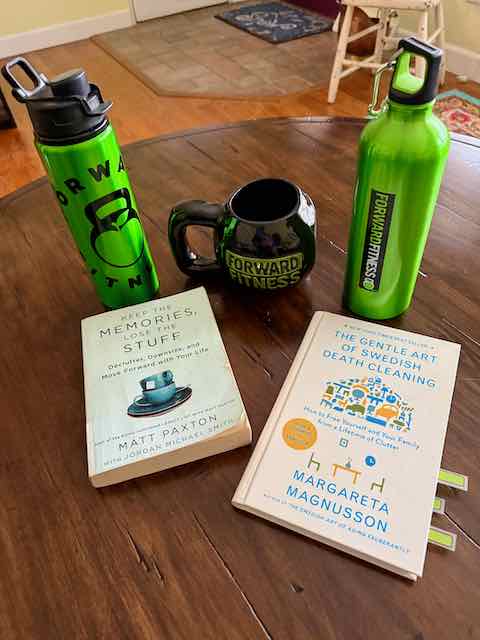
Paxton’s book provides concrete steps on how to downsize your things. He lists specific organizations and groups that you can use to donate, sell or trash your belongings. He does this work as a profession and the book contains stories of clients and how he has helped them de clutter and downsize for various different reasons.
Margareta Magnusson’s The Gentle Art of Swedish Death Cleaning takes a softer, more philosophical approach. Despite the alarming title, the book is warm, funny, and lightly self-deprecating. Magnusson frames decluttering as an act of love, a way of easing the future for those who come after you. Her voice is calm, humane, and reassuring—less “do this now” and more “consider this when you’re ready.”
That gentleness is also the book’s limitation. Much of the advice is intuitive, even obvious, and readers looking for structure or clear guidance may find themselves wanting more. The cultural framing—rooted in Swedish norms around modesty and practicality—doesn’t always translate seamlessly, and the book sometimes leans on charm where specificity would help.
Read together, these books form a kind of dialogue. Paxton asks you to act; Magnusson asks you to reflect. One focuses on consequences, the other on care. Neither fully resolves the deeper question at the heart of decluttering: why objects hold so much meaning in the first place, and why letting go can feel like erasure rather than freedom. One thing that both authors acknowledge is that our belongings tell a story and those stories are often behind the reasons we have trouble letting go of things. They also acknowledge that having opportunities to tell those stories is vital in the process of letting those things go.
What they do offer, collectively, is permission. Permission to question what you’re keeping and why. Permission to curate your life with intention rather than guilt. And perhaps most importantly, permission to accept that no system—gentle or efficient—will ever make this process entirely painless.