
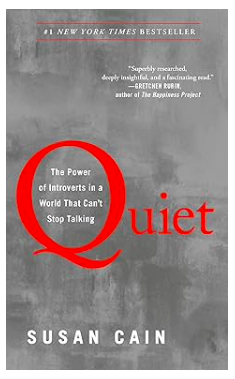
Quiet: The Power of Introverts in a World That Can’t Stop Talking by Susan Cain
Quiet by Susan Cain is a book that has been on my TBR (to be read) list for several years now. My interest in this book comes from the fact that I am an introvert. But I am an introvert that for the most part has figured out, through a lot of trial and error, how to function and overcome some of my introvert tendencies, in a society that is geared for extroverts, which is basically what this book is about.
Cain herself is an introvert and the main idea of the book is pretty straightforward: our society tends to favor extroverts—people who are outgoing, talkative, and thrive in group settings—while often overlooking or undervaluing introverts. Cain makes the case that introverts bring just as much (if not more in certain situations) to the table, especially when it comes to deep thinking, creativity, and leadership.
The book is broken into four parts.
Part 1: The Extrovert Ideal – In this section of the book she discusses how the American culture has become more pro- extrovert over the years. Her ideas are researched based and Cain talks about how workplaces and schools have shifted toward group work, open offices, and constant collaboration. While that might work great for some people, it can be exhausting—and not nearly as productive—for others. It definitely made me stop and think about how often we assume that louder equals better.
Part 2: Your Biology Your Self – This part of the book delves into the nature versus nurture idea. Why are some people extroverts and others introverts. This section was very reflective for me. Growing up in what I always considered to be a family of extroverts, I often wondered, why was I the “quiet” one? In really thinking about this, I think my mom was probably more of an introvert than I ever realized and I can see now how things that she did and things that she encouraged me to do over the years helped me overcome some of my shyness.
Part 3: Do All Cultures Have an Extrovert Ideal – This section explores how being an extrovert or an introvert is perceived in different cultures. America and European societies seem to favor extroverts while many of your Asian cultures favor introverts.
Part 4: How to love, How to work – In this section Cain looks at how extroverts and introverts live and work together. One of my favorite sections of the book was when she explores the relationship between Eleanor and Franklin Roosevelt. Theirs was a true marriage of an introvert and extrovert that seemed to work. The last chapter of the book is about how the American education system favors extroverts and things that educators need to think about when working with introverted students.
Cain ends the book with resources and practical tips for individuals that identify themselves as introverts and ways to help them cope in an extroverted society.
This book was published in 2012 and I do think that introverts have kind of come into their own since then. You see a lot more research on extroverts versus introverts these days and I think it’s safe to say that while most people probably fall mostly into one category or the other, there is some overlap.
This was an interesting read. It’s one of those books that doesn’t necessarily tell you to change your life, but it does shift how you see people—and that’s just as valuable. Another take away for me is the idea that introversion isn’t something that needs to be “fixed.” It’s just a different way of interacting with the world. Cain also points out that introverts can absolutely step into more extroverted roles when needed—it just tends to take more energy.
For those who consider themselves more introverted, the book has some good insight into ways to help you overcome situations that might cause you anxiety (I’m a big believer in deep breathing) and for those who consider themselves extroverts this book could help you better understand those people in your life who might not be quite as outgoing as you.